
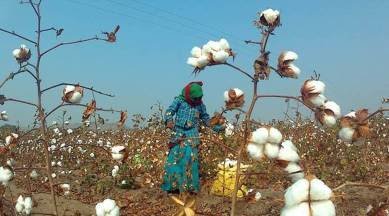
Punjab had been flying high in cotton productivity for the last three years, but this year it seems to have taken a nosedive.
As per initial reports, the state’s cotton productivity is down by around 45% this year.
According to the details procured from the Punjab Agriculture Department, this year the state’s average productivity is recorded at 363 kg lint per hectare (147 kg lint per acre), while the raw cotton productivity is 1,089 kg per hectare (441 kg per acre).
Lint is a white fibre which is recovered from ginned raw cotton. In the ginning process, for every quintal (100 kg) of ‘kapas’ (unginned cotton or raw cotton), the recovery of lint is 33-36 kg and of seed is 63-66 kg.
According to the Punjab Agricultural University (PAU), Ludhiana, Punjab has recorded 651 kg lint (1,953 kg raw cotton per hectare), 690 kg lint (2,070 kg raw cotton) and 652 kg lint (1,956 kg raw cotton) per hectare in 2019-20, 2020-21 and 2021-22, respectively.
As per the records, Punjab’s cotton productivity this year is almost 45% less than the last year.
Experts said that cotton crop is being attacked by plant pests like pink bollworm and white fly, and even stunted growth of plants was observed in several fields. Scientists must focus on managing these issues and making farmers aware of them, prevention methods and other cotton crop-related techniques, the experts added.
Meanwhile, PAU’s Regional Research Centre (RRC), Bathinda, has already developed 57 cotton crop varieties to date.
The experts realised the need for massive attention towards this crop due to attacks of various pests, and in this regard an “Inter-State Consultative and Monitoring Committee” meeting was held on December 22 in Bathinda under the chairmanship of Dr Gurwinder Singh, Director of Agriculture and Farmers’ Welfare, Punjab, to take stock of the pink bollworm attack on cotton last year and to review the action plan for its management during Kharif 2023-24.
Dr S S Gosal, vice-chancellor of PAU Ludhiana, also participated in this meeting along with the chief agricultural officers from various cotton-growing districts of the state and scientists from PAU, HAU Hisar and ICAR-CICR Sirsa.

